The Operational Case for AI Video: Why Training Libraries Rot (And How to Stop It)
The enterprise Learning and Development (L&D) landscape is undergoing a structural shift—not driven by generative creativity, but by the mounting weight of content obsolescence.
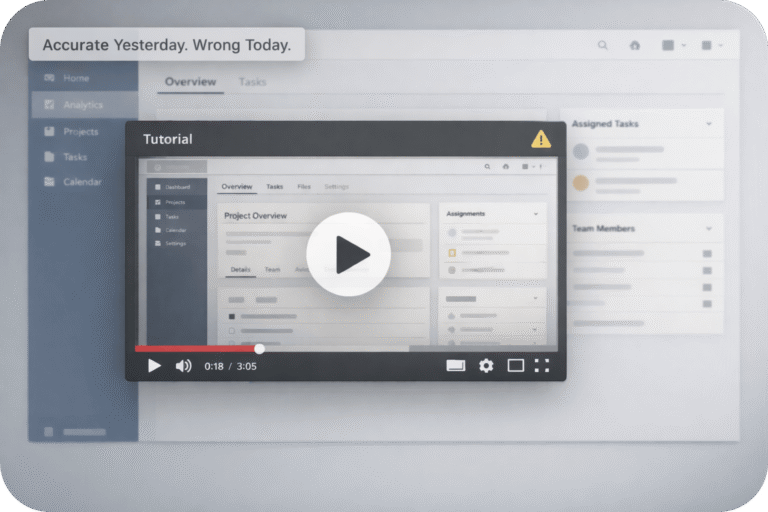
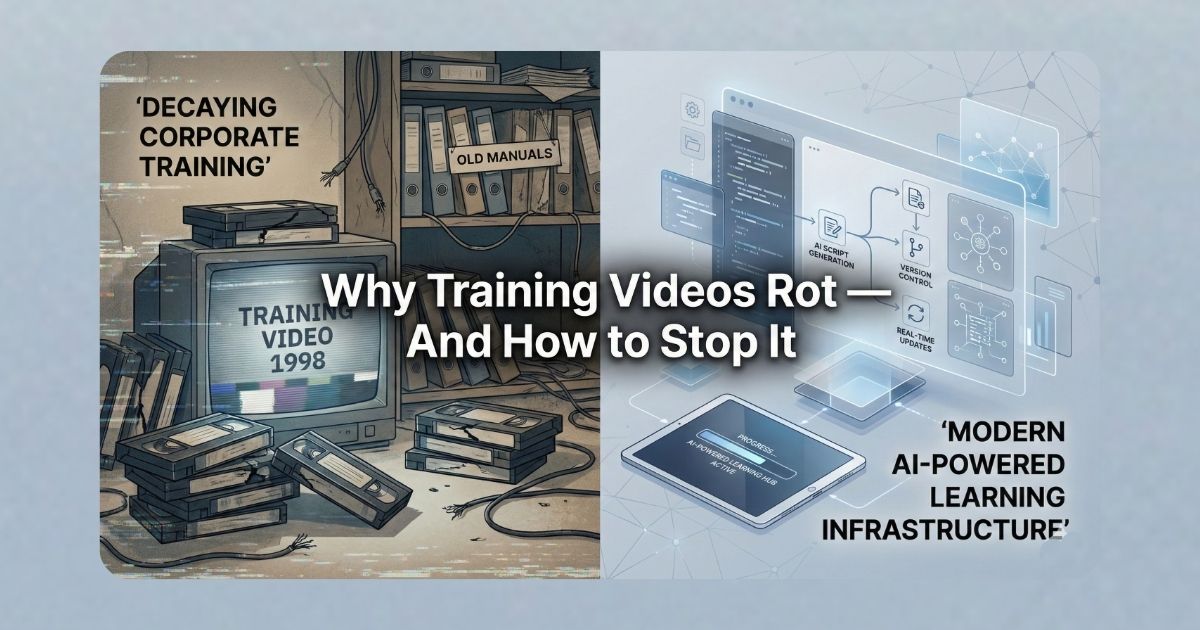
A fast visual summary (why libraries rot)
Three forces compound into “instructional debt”:
Every L&D team has a graveyard of “finished” videos. You know the ones. Produced eighteen months ago with high hopes and higher budgets. The lighting is perfect. The audio is crisp. The acting is professional.
And today, they sit unused inside the LMS.
Not because the production quality failed—but because the information inside them decayed.
For decades, instructional design has treated video as a high-fidelity artifact: produce, publish, and eventually abandon it when modification becomes too expensive. In regulated industries, high-growth technical environments, and global organizations, that model is no longer viable.
Training videos decay faster than they can be produced, creating a form of maintenance debt that undermines compliance, learner trust, and operational agility.
The real cost of training video isn’t production.
It’s maintenance.
The Decay Cycle of Traditional Training Video
To understand why a new approach is required, we first need to examine how the current model fails. The modern Instructional Designer’s biggest enemy isn’t learner engagement—it’s information volatility.
What Actually Breaks First
When a traditional training video is published, degradation begins immediately. Not at the conceptual level, but at the level of specific, verifiable details:
- UI screenshots drift after a product update
- Threshold values change due to regulation (e.g., $50 becomes $25)
- Legal definitions no longer match statutory language
These aren’t cosmetic errors. They are compliance and credibility risks.
Why Re-filming Rarely Happens
Correcting a 15-second error inside a 5-minute video triggers what most teams quietly accept as the re-filming tax:
- Talent coordination: Original presenters are unavailable or no longer match the series
- Budget re-approval: Minor fixes inherit major production minimums
- Rationalization: Teams add errata PDFs or LMS notes instead of fixing the video
Over time, “temporary workarounds” become permanent institutional behavior.
The Learner Trust Problem
This leads to what I call the Uncanny Valley of Obsolescence.
Learners notice immediately when a workflow shown in training contradicts yesterday’s update, or when a compliance video explains a process that no longer exists. At that moment, the social contract of training breaks.
Trust erodes faster than engagement ever does.
The content isn’t ignored—it’s actively discounted.
This is why training libraries don’t age gracefully. They rot.
If you’re seeing decay already
I’ve documented the full framework and included a downloadable L&D Bonus Pack (script governance, compliance narration, and localization readiness) here:
👉 https://aicomparelab.com/synthesia-review-training-documentation/
Everything is designed to help teams deploy AI video as maintainable infrastructure—not as content.
Use Case #1: Compliance & Policy Training Under Constant Change
The clearest structural fit for a new approach is regulated industries: banking, pharma, energy, insurance.
Scenario:
A global bank updates its AML policy. A reporting threshold changes. The existing training video is now legally incorrect.
Traditional failure:
The outdated video remains live, supplemented by a PDF that contradicts the narrator. Auditors flag the discrepancy. The video becomes a liability.
Infrastructure approach:
Compliance video should behave like documentation. Treat the script as the source of truth. Edit the threshold once. Regenerate the video. Preserve an audit trail showing when the update deployed.
If content is legally binding and changes more than once per year, it must be maintainable by design.
This is exactly why governance-first scripting frameworks matter—before any tool is deployed.
Use Case #2: Global Training & Localization Drift
The second failure mode appears when organizations expand globally.
Scenario:
A US-based onboarding series performs well domestically. Budget constraints eliminate professional dubbing for APAC and EMEA.
Traditional failure:
Teams rely on subtitles. Engagement drops. Comprehension suffers. Worse, international teams operate on older versions of policy and process.
Infrastructure approach:
The challenge isn’t translation—it’s synchronization.
When a single governed script propagates across languages, updates apply everywhere simultaneously. Lip-synced localization preserves clarity without introducing regional drift.
This requires localization-ready scripts from day one—another area where most teams fail before tools even enter the picture.
Use Case #3: Onboarding & Product Training That Never Stops Changing
The third high-volatility zone is internal software and product education.
Scenario:
Agile teams ship updates monthly. Training recorded today is obsolete by release.
Traditional failure:
Product managers record ad-hoc screencasts with inconsistent audio, pacing, and terminology. The library fragments. Professional credibility erodes.
Infrastructure approach:
Decouple narration from capture. Re-record the screen. Update the script. Preserve a consistent instructional voice regardless of who authored the change.
The problem was never video quality.
It was version control.
The Mental Shift: Video as Learning Infrastructure
AI video only works when leaders stop treating it as a creative suite and start treating it as learning infrastructure.
This isn’t about replacing instructors.
It’s about removing the friction that prevents accuracy.
The most effective teams separate their strategy clearly:
Identity Video (Human)
- Values, leadership messages, trust transfer
- Moments requiring vulnerability and presence
Utility Video (Infrastructure)
- Process, policy, compliance, onboarding
- High-maintenance content that must stay correct
When video behaves like infrastructure—similar to documentation or code—it becomes a living system instead of a static monument.
Where Tools Like Synthesia Actually Fit
This is where platforms like Synthesia belong in the conversation.
They are not actors. They are compilers.
Their value isn’t emotional nuance—it’s the ability to treat scripts as a single source of truth, regenerate outputs, localize instantly, and reduce maintenance cost by orders of magnitude.
Used correctly, they neutralize the triad of decay:
- Re-filming cost
- Localization latency
- Audit risk from outdated content
I’ve mapped this operational model in detail here:
👉 https://aicomparelab.com/synthesia-review-training-documentation/
The Bonus Assets: Preventing AI Video Misuse
One warning is necessary.
AI video tools fail when deployed without governance. Ease of creation leads to content bloat, inconsistency, and new forms of risk.
The failure mode isn’t the tool.
It’s ungoverned access.
Before granting licenses, mature L&D teams establish:
- Script versioning workflows (content as source code)
- Compliance narration standards (pronunciation, pacing, scope control)
- Localization readiness rules (what must never be translated)
- Stakeholder ROI framing based on decay cost—not production savings
I’ve packaged these into L&D-specific prompts and templates designed to make AI video boring, predictable, and audit-safe—which is exactly what infrastructure should be.
They’re available alongside the full review for teams that want to deploy this responsibly.
Decision Guidance: Should Your Team Use This?
AI video infrastructure is not universal. Apply this structural fit test.
Use it if:
- Information shelf-life < 12 months
- Accuracy and compliance matter more than persuasion
- You support 3+ languages
- You prefer OpEx over recurring re-filming projects
Avoid it if:
- Content is evergreen
- Emotional trust transfer is the goal
- Vulnerability and human presence are required
How to Evaluate Synthesia Without Buying Blind
If your organization suffers from instructional debt, Synthesia is currently the strongest enterprise-grade option.
Evaluate it on:
- SOC 2 compliance
- SCORM exports (you own the asset)
- Script-centric architecture
- Workspace-level governance
Avoid platforms that treat video as disposable output rather than maintainable systems.
👉 Explore Synthesia’s Enterprise Capabilities:
https://www.synthesia.io/?via=Explore-Now
The governance prompts and script-engineering assets included in my review help teams avoid robotic pacing, mispronunciation, and compliance risk from day one.
Is our proprietary training data used to train AI models, and do we own the generated videos?
Enterprise-grade AI video platforms typically separate customer scripts from public model training and limit usage to “inference” (generating output from an already-trained model). On enterprise plans, customers generally retain commercial ownership of the final rendered video files (e.g., MP4), while the underlying stock avatar remains licensed from the vendor. In practice, you own the output, but you’re renting the “digital actor,” which can create platform dependency for future edits.
Do AI avatars reduce learner trust or trigger the “uncanny valley” in corporate training?
For hard-skill training (procedural, factual, compliance), research and field deployment patterns show AI avatars can perform comparably to human presenters on knowledge transfer—because the instructor is mainly an “information carrier.” A trust gap tends to remain for soft-skill and culture-heavy training (leadership, empathy, sensitive topics), where emotional authenticity and micro-expressions matter more. The strongest strategy is using AI for utility learning and humans for identity/trust-transfer moments.
How does script-based editing reduce “video maintenance debt,” and what savings are realistic?
AI video turns video into a script-governed asset: you update the script (source of truth) and regenerate the video instead of reshooting. That collapses the marginal cost of updates and sharply reduces “video maintenance debt” (outdated content backlogs). Realistic savings typically come from eliminating filming logistics and from lifecycle ROI—especially in Year 2+ when traditional updates often cost a large fraction of the original production budget.
How do SCORM exports work (streaming vs. offline), and what happens if we cancel the subscription?
Many platforms use a “streaming SCORM” approach where the LMS package is a lightweight wrapper that streams the video from the vendor’s servers—making updates fast, but increasing vendor dependency. If the subscription ends, streamed content may break inside the LMS. For long-term control, teams often download and archive MP4 exports (and, where needed, publish “thick” SCORM packages via an authoring tool), trading auto-updates for ownership and continuity.
Synthesia vs. HeyGen vs. Colossyan: which is best for enterprise L&D?
The market has segmented by use case: Synthesia is commonly positioned as the enterprise governance-and-scale option; Colossyan is often favored by instructional designers who want learning-native features like in-video interactivity; and HeyGen is often recognized for pushing visual fidelity and generative flexibility. The best choice depends on your primary constraint: security/governance, course design interactivity, or external-facing realism.
Disclosure & Final Thoughts
Disclosure: Some links included may be affiliate links. If you choose to explore tools through them, I may earn a commission at no additional cost to you. My analysis is based on operational stress-testing in real enterprise environments.
AI video won’t save L&D by being creative.
It saves L&D by making accuracy cheap.
When video becomes infrastructure, training stops rotting—and starts living.