Why Corporate Training Videos Quietly Fail Over Time
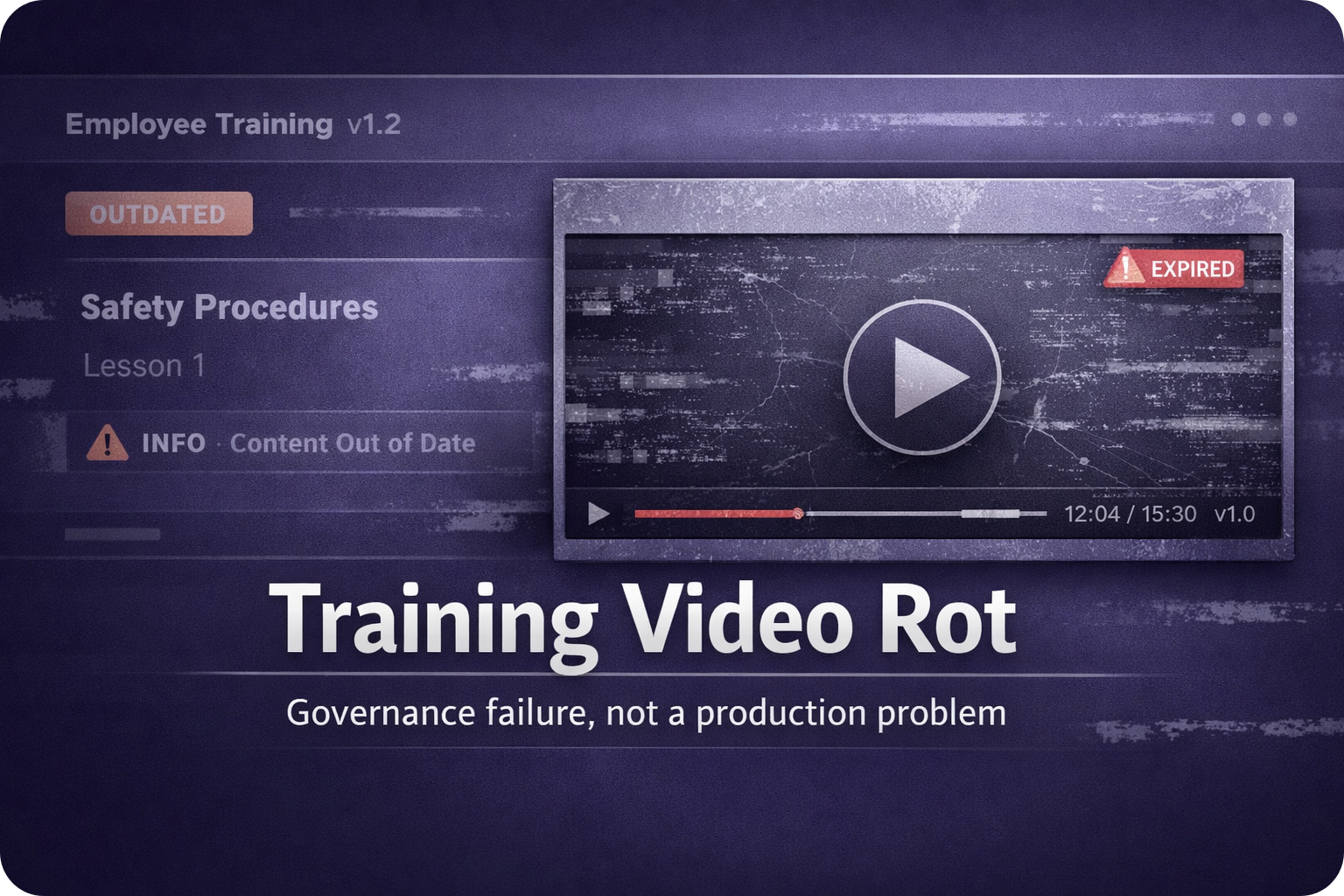
Training Video Rot Is a Governance Failure, Not a Production Problem
The real cost of training video is not production. It is maintenance. This is the lifecycle cost most organizations underfund, under-govern, and then pay for later in audit remediation and operational drift.
Fast executive summary (scannable)
Three compounding forces drive video decay:
Page identity and positioning
This is an operational blog for L&D Operations leaders, Compliance and Risk stakeholders, and Enablement and Knowledge Architecture teams.
It is not a creativity piece. It is not a “GenAI will change everything” narrative. It is not a marketing use case library.
Core thesis (and the only thesis that matters here): The real cost of training video is not production. It is maintenance. This is the lifecycle cost most organizations underfund, under-govern, and then pay for later in audit remediation and operational drift.
Affiliate disclosure
This article contains affiliate links. If you choose to evaluate Synthesia through those links, I may earn a commission at no extra cost to you.
Early disclosure and funnel transparency
There is no hidden intent here.
This is a two-step path designed for enterprise buyers who need more than a vendor demo:
- Blog (diagnosis + decision filters)
- Governance layer (implementation reference) and only then tool evaluation
If you are looking for a quick tool recommendation, you are in the wrong place. If you are accountable for accuracy over time, audit defensibility, and lifecycle control, continue.
The operational pain
Most training libraries fail in a boring way.
The content looks polished. The narration is confident. The visuals are clean.
And a new hire still can’t complete the workflow because the button moved, the label changed, or the approval threshold was updated. Video does not become “wrong.” It becomes 5% wrong. That 5% forces the learner to do continuous error-correction, which quietly converts training into cognitive friction and support tickets.
The maintenance thesis is not abstract. In regulated environments, “accurate yesterday” is often the same as “non-compliant today.”
Core framework: the decay cycle (instructional debt)
Call it what it is: Instructional Debt. It accrues when the “map” (training) diverges from the “territory” (work-as-done). Unlike physical infrastructure, knowledge infrastructure degrades primarily through environmental change: software updates, policy edits, and operational optimizations.
What breaks first
The first failures are rarely the big ideas. They are the micro-facts:
- Interface drift (the screen no longer matches)
- Terminology shifts (“Client” becomes “Customer”)
- Threshold decay (limits, rates, tolerances)
- Process forking (regional variations become unofficial standards)
Why updates don’t happen
Because the enterprise funds “launch” and starves “lifecycle.” Projects end. Owners change. Minor changes never trigger the governance threshold. The asset dies by a thousand cuts.
How learner trust collapses
When official guidance becomes unreliable, the workforce is trained to ignore it. They ask peers, build local PDFs, paste steps into chats, and normalize uncontrolled change. That is not “engagement.” That is the hidden factory of ungoverned operations.
Implementation reference: video maintenance and change-control toolkit
Implementation reference: Video Maintenance and Change-Control Toolkit (operational framework + governance layer)
Synthesia Review for Training & Docs – Is It Worth It? | AI Compare Lab
Use it as a change-control baseline: ownership, verification cadence, versioning rules, and distribution strategy.
Three enterprise use cases (failure mode + infrastructure resolution)
Compliance and policy training
Scenario
A regulated policy changes (rate, control threshold, procedure step). Training content “mostly matches” except one critical statement.
Traditional failure mode
The team defers the update because re-recording is expensive. The workaround becomes errata: emails, PDFs, or verbal coaching that contradict the official module. In audits, “training record” exists, but it proves attendance to the wrong version, which can nullify the evidence value.
Infrastructure-first resolution
Treat policy video as a governed artifact with an edit-regenerate-publish loop, and define when you must preserve an immutable historical record versus when you can “hot swap” content. In high-stakes compliance, immutability can be a feature. Your architecture must decide when dynamic updating is allowed and how it is logged.
Global training and localization drift
Scenario
A global SOP is translated into multiple languages. One region customizes visuals to match their localized UI.
Traditional failure mode
The master changes. Local versions fall behind. The organization now has multiple “true” trainings. Audits fail on inconsistency, not just correctness.
Infrastructure-first resolution
Use a single distribution surface where the learner is served the correct localized track automatically, but govern the exception path: once a region swaps visuals, you have created a semi-automated branch that requires explicit maintenance ownership and regression checks when the master changes.
Rapidly changing product or software training
Scenario
SaaS UI ships bi-weekly. A ten-minute enablement video becomes slightly wrong after one sprint.
Traditional failure mode
The team updates scripts quickly, but the LMS pipeline is slow. The “source of truth” and the “deployed reality” diverge for days or weeks, creating a version gap.
Infrastructure-first resolution
Decouple the SCORM wrapper from the streamed video so the deployed course can pull the current version without re-uploading a massive package. This solves update latency, but introduces audit-trail and vendor-dependency risks that must be governed, not ignored.
Mental shift: identity video vs utility video
You need a modality boundary.
Identity Video (Human)
Used when the goal is trust transfer, emotional authenticity, leadership signaling, ethics, apologies, or high-stakes cultural messaging. Synthetic delivery here often triggers “corporate cringe” and erodes credibility because the medium contradicts the intent.
Utility Video (AI)
Used when the goal is procedural clarity, consistency, and fast updates: SOPs, system steps, configuration tasks, and operational logistics. In these contexts, learners often prefer clarity and pacing over “presence,” especially when the alternative is low-quality SME recordings.
Explicit warning: AI video fails without governance. Lower friction increases volume, and volume without lifecycle control becomes unmanageable. This is the volume-maintenance ratio problem.
Humans remain essential. Not as “creators,” but as owners of intent, verification, and accountability.
Where Synthesia fits
Synthesia is relevant here only if you frame it correctly: not as production software, but as maintenance infrastructure.
The infrastructure rationale
- Script-centric: the script behaves like source code, and the video behaves like a compiled artifact. This makes updates operationally similar to editing documentation.
- Regeneration engine: changing a sentence can regenerate the corresponding audio and lip-sync performance without re-shooting. That collapses the re-filming tax for volatile details like thresholds and labels.
- Single-source-of-truth layer: version history and regeneration loops support a maintained asset, not a one-time export.
- LMS strategy options: a SCORM dispatch model can keep the LMS wrapper stable while the video updates, reducing administrative friction and course versioning latency.
Calm evaluation link (enterprise capabilities):
https://www.synthesia.io/?via=Explore-Now
- The same “hot swap” capability that improves maintenance can weaken audit defensibility if you cannot prove what a learner saw at completion time.
- Embedding or streaming creates vendor-hosting dependency and network/security considerations that are not optional in zero-trust environments.
- Governance and access controls are not “enterprise add-ons.” They are the product in this category.
Explore Synthesia enterprise capabilities
https://www.synthesia.io/?via=Explore-Now
Secondary: Use a governance baseline first. If you do not have change control, do not scale production.
Governance and implementation toolkit (risk management layer)
Tools fail without governance. Faster generation only accelerates drift if validation, ownership, and deployment rules are missing.
A practical governance layer should include:
Script versioning (treat scripts as code)
Maintain scripts in a controlled repository that is independent of any single vendor tool. This is your durable source of truth.
Access controls and lifecycle management
You need role separation, RBAC, and identity lifecycle controls so terminated users cannot retain content access. This is not theoretical risk; it is basic operational hygiene.
Localization rules (propagation vs controlled branching)
Define what must auto-propagate and what can be regionally customized, and document the maintenance obligation created by custom visuals.
Verification cadence (truth SLA)
Require “last verified” metadata and a mechanism for frontline users to flag broken content as a defect, not a suggestion.
ROI framed correctly
ROI is not “hours saved creating videos.” It is decay cost avoided: fewer support tickets, less shadow documentation, reduced audit remediation, and shorter time-to-accuracy.
Implementation reference (same toolkit name, used consistently): Video Maintenance and Change-Control Toolkit
Synthesia Review for Training & Docs – Is It Worth It? | AI Compare Lab
Decision filter
Use it if
- You have high-volatility procedural content where accuracy changes faster than your video production cycle.
- You can implement ownership, review cadence, and controlled deployment paths (including how you handle “what the learner saw”).
- Your goal is utility video: SOPs, software steps, operational logistics, documentation reinforcement.
Avoid it if
- You plan to use AI avatars for leadership trust moments (culture, ethics, DE&I, apologies, sensitive change). That is a trust failure mode.
- You cannot get IT security alignment for streaming, whitelisting, bandwidth, and identity controls.
- You do not have the operational capacity to govern scale. Lower creation friction can explode volume, and volume without lifecycle ownership becomes unmanaged liability.
Evaluation criteria checklist
Use this checklist to avoid evaluating the wrong thing.
Security and compliance posture
- SOC 2 Type II verification and contractual language that forbids training on your inputs (scripts are data).
- Identity controls: SSO, SCIM, and RBAC for lifecycle and insider-risk reduction.
SCORM strategy (do not treat this as a box check)
- Decide whether you need immutable archival packages for audit defensibility, or whether a dispatch/streaming model is acceptable with proper change logging.
- If you require granular behavioral analytics (xAPI depth), validate how you will capture it, and whether you need an external authoring layer.
Asset ownership and vendor dependency risk
- What is your exit path if you stop paying? What breaks if the streaming domain is blocked? What is the acceptable downtime model?
- Where does the script live as the source of truth: only inside the tool, or also inside your controlled repository?
Accessibility defensibility
- Confirm VPAT availability and test the player in your environment (keyboard navigation, screen readers, caption tracks). Do not accept “captions exist” as proof.
FAQ
How do we maintain version control and lifecycle accuracy without creating a Day 2 maintenance nightmare?
Treat scripts as the governed source artifact, not the rendered video. Define ownership, verification cadence, and a change-control path for “minor” changes so they do not accumulate into major failures. Also plan for the volume-maintenance ratio: if creation friction drops, your inventory can explode, and your governance model must scale with it.
Do AI avatars reduce learner trust or create “corporate cringe” that harms high-stakes messaging?
Yes, in specific content categories. There is a clear trust hierarchy: leadership, ethics, DE&I, and sensitive communications demand human presence. AI delivery often signals disengagement and can undermine the message. Use AI delivery primarily for utility video where clarity and update speed matter more than emotional authenticity.
What are the legal risks around employee likeness, digital twins, and post-termination consent?
The risk is not abstract. Synthetic avatars separate performance from performer, which creates post-termination and consent-revocation exposure. Your governance must include explicit consent scope, revocation handling, and strict access controls for high-value personas. If you cannot govern this, do not build critical libraries on custom likeness.
How do we integrate cloud-based AI video streaming into a zero-trust IT environment?
Assume streaming will be blocked until proven otherwise. Whitelisting can be complex due to CDNs and wildcard domains, and concurrent viewing can create a real network tax. For some environments, exporting and hosting internally will be required. This is an architecture decision, not a “pilot surprise.”
Do AI video players and content meet accessibility requirements, or are we creating an inclusion liability?
Do not confuse burned-in captions with accessibility. Screen readers require text tracks. Players must support keyboard navigation without traps. In many enterprises, the safer pattern is exporting MP4 + proper caption files and hosting in a vetted LMS player, unless the vendor player is proven compliant in your environment.
Closing and disclosure
Enterprise training is not media. It is operational infrastructure.
The question is not whether you can create video quickly. The question is whether you can keep it true cheaply, prove what was seen when it mattered, and prevent the drift that pushes work into shadow channels and audit traps.
AI does not save L&D by creativity. It saves L&D by making accuracy cheaper than drift.
Affiliate disclosure
This article contains affiliate links. If you choose to evaluate Synthesia through those links, I may earn a commission at no extra cost to you.